


In Phnom Penh, China is regarded as the core economic and strategic partner as Cambodia seeks to diversify its sources of economic growth, modernize, connect its infrastructure, and integrate its economy with the region and the world at large.
Before you can even start to put in place new and effective regional governance mechanisms, you have to first find agreement on a rather fundamental question: what exactly is the region that needs to be governed?
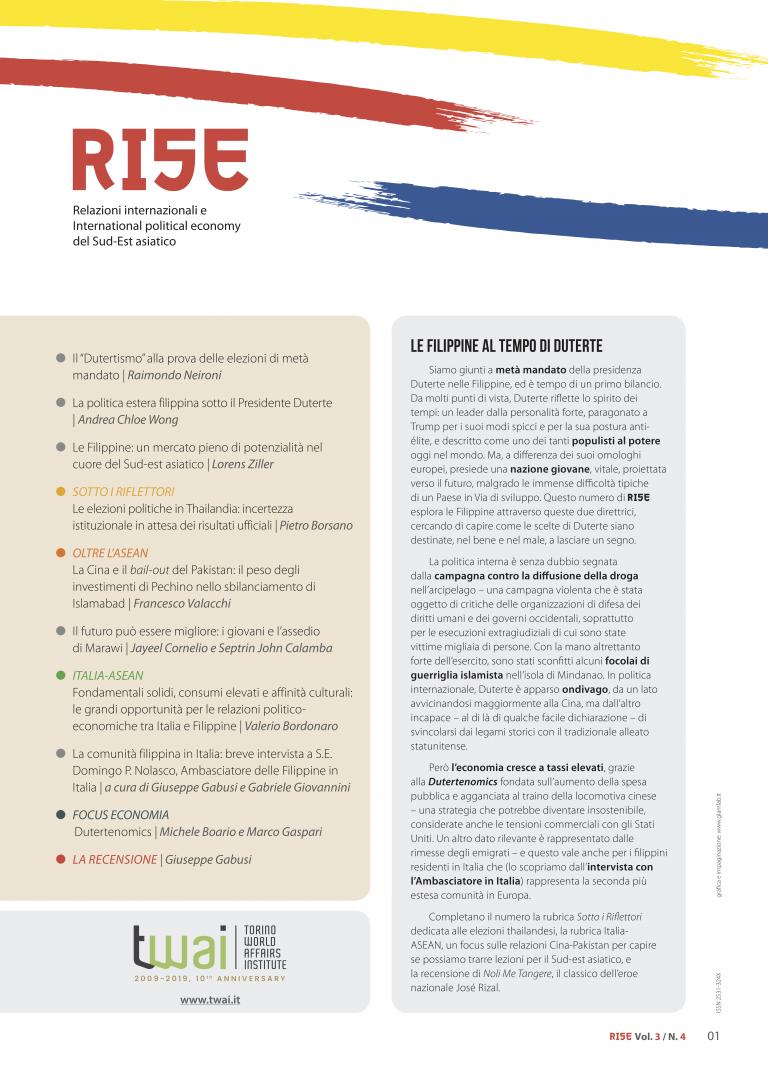
La Thailandia torna al centro. O meglio, considerata la sua posizione geografica, collocata tra Myanmar, Cina, Cambogia, Laos e Malaysia, al centro del Sud-est asiatico la Thailandia è sempre stata. Ma, in seguito al colpo di stato militare del 2014, il Paese aveva subito un certo isolamento da parte dell’Occidente.
[IT] Gabriele Giovannini (Università degli Studi di Torino) intervistato da Angela Gennaro, nel suo articolo “Vita a rischio del Mekong da cui dipendono le sorti di 60 milioni di persone”, su Il Reportage.
China’s increased ‘soft power’ in terms of economic and cultural relations in Southeast Asia clearly presents a great opportunity for Vietnam while posing new challenges in terms of security, politics and diplomacy.
“Italy is home to the Torino World Affairs Institute (T.wai), which maintains strong Asia-focused research programmes. France is home to think tanks such as the Institut français des relations internationales (IFRI) and the Institut de relations internationales et stratégiques (IRIS), both of which have well-established expertise on Asia.”
Anna Caffarena is Full Professor of International Relations at the University of Torino and the Director of its Department of Cultures, Politics and Society. She has served as the first President of the Torino World Affairs Institute.
Prof. Giuseppe Gabusi is Associate Professor of International Political Economy and Political Economy of East Asia at the Department of Cultures, Politics and Society of the University of Turin. He is Head of T.wai's Indo-Pacific Program.
Pietro Masina is a non-resident Research Fellow at T.wai and a Full Professor of International Political Economy, History and Institutions of East Asia at the University of Naples “L'Orientale”.
Prof. Giorgio Prodi is Associate Professor of Applied Economics at the University of Modena and Reggio Emilia. He serves as Vice President of T.wai, the Torino World Affairs Institute.