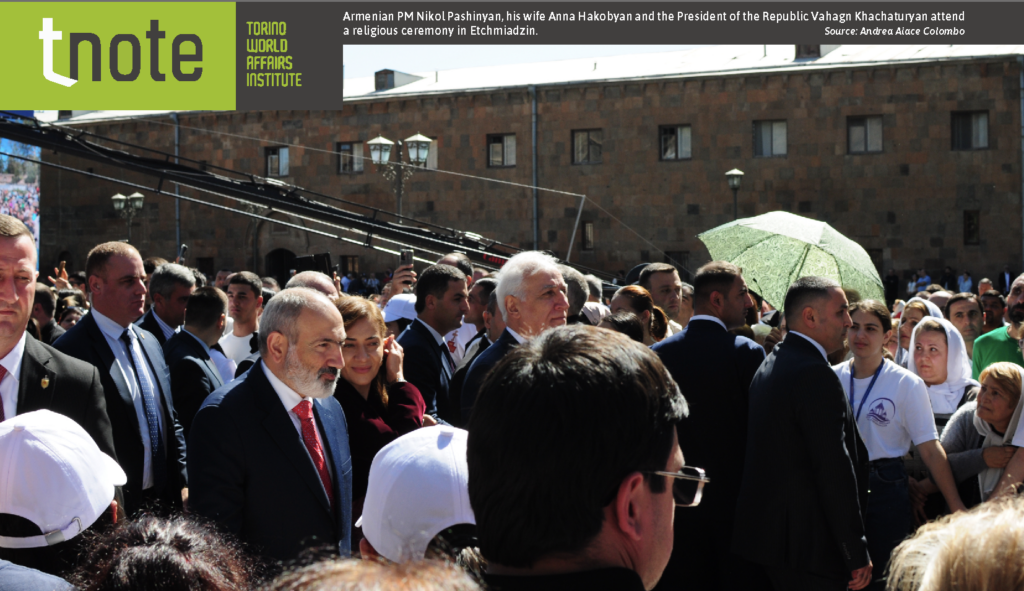
In the past seven years, Armenia has gone through a roller-coaster of changes, crises, challenges, and upheavals. In 2018 the mass movement of civil disobedience known as the “Velvet Revolution” succeeded in ousting the incumbent authoritarian regime and bringing the journalist-turned-politician Nikol Pashinyan to power as Prime Minister. The country embarked on a slow but steady path toward democratization, only to find itself, two years later, embroiled in the Second Nagorno-Karabakh War, which enabled Azerbaijan to reconquer the districts seized by Armenian forces in the early 1990s and effectively marked the end of the Nagorno-Karabakh Armenians’ aspirations for independence. An intense round of meetings and negotiations unfolded and in the summer of 2025, after sustained efforts by the US Administration, Armenia and Azerbaijan signed a series of agreements, seeking full normalization of relations and a lasting path to peace. These included establishing a transit corridor across southern Armenia, initialing of a document intended to become a formal peace treaty, and formally dismantling of the OSCE Minsk Group. Such a dense series of events raises the question of what influence the relatively new Armenian democratic government might have had, first in the outbreak of war in 2020 and then in the peace process.
Within academia, much of the literature has drawn on Mansfield and Snyder’s theory on “Democratization and War” and identified Pashinyan’s assumed populist stance, nationalist rhetoric, revolutionary recklessness, and overall inexperience as some of the main causes of the 2020 escalation. Yet, while Pashinyan’s nationalist turn is evident and is most often traced to his 2019 speech “Artsakh is Armenia, period!”, his broader posture appears far more nuanced and complex. Indeed, at a closer look, the official statements and speeches issued by the Armenian PM and his government in the years between the Velvet Revolution and the outbreak of war, reveal an ambivalent and internally inconsistent approach, which can be better understood by considering Armenian foreign policy-making both at the individual and bureaucratic levels.
When the Second Nagorno-Karabakh War started, Pashinyan had spent his entire life fighting for democratic change in his country and regarded his movement as a powerful democratic force opposing an old, autocratic one. As soon as he took up the negotiation dossier, he disrupted it by demanding the return of Nagorno-Karabakh’s authorities to the negotiation table and advocating for the involvement of all three populations in defining peace. These proposals, reinforced by constant references to Armenia’s commitment to a peaceful resolution of the conflict, reflected his belief in the possibility of a democratic and “popular” settlement. At the same time, however, the Armenian bureaucratic apparatus was suffering significant setbacks. As confirmed by a former Armenian official I interviewed in April 2025, the foreign policy-making process was hindered by groupthink dynamics, excessive centralization, prioritization of domestic issues and anti-pluralist tendencies within coordination bodies – all typical features of a post-revolutionary regime composed of a ruling class mostly new to politics, which ultimately weakened Armenia’s ability to respond to a changing and challenging environment.
The interaction between these two levels led Pashinyan to attempt a “democratic turn” in the negotiation, something strongly opposed by Azerbaijan, which feared a possible breakthrough and had, in fact, been preparing a military solution for years. Thus, consistent with Mansfield and Snyder’s theory, the Armenian democratization did indeed contribute to the outbreak of war. Yet, it did so primarily because democratic convictions – rather than nationalism – disrupted the negotiation format which, albeit stalled, had been agreed by Pashinyan’s predecessors and the Azerbaijani leadership.
After Armenia lost control of the Nagorno-Karabakh territories in 2020, the balance of power in the region changed dramatically. Since 1994, the Armenian regime had consistently refused to accept any compromise in the negotiation and removed anyone attempting it. The reason was that the old leadership built its political legitimacy on the 1994 victory, freezing domestic politics around a “security vs. democracy” dichotomy – an unsustainable status-quo, which hindered Armenia’s statehood, preventing it from building a mature political system and solid relations with the international community. In contrast, strengthened by his election-based legitimacy and lack of personal ties with Nagorno-Karabakh, Pashinyan intensified efforts to reach a compromise with Azerbaijan following the military defeat and to redefine Armenian nationalism, introducing what he called “the ideology of Real Armenia” and engaging in a series of highly contested moves to align Armenia’s imagined borders with its internationally recognized ones: he officially recognized Azerbaijan’s sovereignty over Nagorno-Karabakh; launched a border delimitation process in which he ceded a few villages; attempted to remove Mount Ararat from national symbols; clashed with the Apostolic Church and downplayed the priority of genocide recognition in relations with Turkey. In his own words: “We didn’t lose Nagorno-Karabakh, we found the Republic of Armenia”.
While Ilham Aliyev’s agency and the pressure put on Baku by the US played a crucial role in leading the parties to sign the agreements in August 2025, Pashinyan’s openness and willingness to compromise should not be understated: the pre-revolutionary leadership would hardly have accepted any of Azerbaijan’s demands, thus making it impossible to reach any agreement.
The Armenian case shows the complexity of democratization amid a frozen conflict, which the previous regime had little interest in resolving. Pashinyan’s actions have been consequential. Driven partly by inexperience and overconfidence and partly by a genuine democratic vision of conflict resolution, the redefinition of Armenian nationalism and the new approach to negotiations first triggered military escalation – giving Aliyev the pretext for a long-planned offensive – and then led to an embryonic peace agreement which could perhaps only have been attempted by a revolutionary and democratically elected government. To be sure, Pashinyan’s boldness earned him accusations of national betrayal, while the opposition – largely tied to the old regime – remains strong, as does Russia’s influence. Yet, Armenia’s fragile democracy has proven unexpectedly resilient in the past seven years and, despite its visible flaws, the 2025 agreement has offered positive prospects – but many risks persist. The June 2026 elections will mark another crucial milestone in Armenia’s political trajectory.
Andrea Aiace Colombo is a recent graduate in International Sciences at the University of Turin, where he specialized in Peace and Conflict Studies.
Download